Racing Classes Explained
The true appeal of Tamiya's Mini 4WD can be found in racing them. Tamiya Inc. has a set of standardized rules that they use in Japan, however most of the US-based tracks have adapted those rules slightly to fit our racing scene. That being said, my local track, DukWho Workshop, follows a set of house rules inspired by official Tamiya Mini 4WD guidelines.
As other tracks may vary their rules slightly as well, it's a good idea to check with your local track to see what they use prior to attending an event.
General Rules
Updated 1/13/2026
The General Rules apply to each class. If there are adjustments to these rules (per class), they will be noted under that class heading below.
- Oil/Grease Leaks: Cars exhibiting oil or grease leaks from the motor, gearbox or drivetrain are not permitted to race. If discovered during tech inspection, the car must be repaired before racing. If discovered during a race, the driver will be disqualified from that race.
- Starting Procedure: Pushing, pulling or flick-starting the vehicle is prohibited. A first offense will result in one (1) warning and a restart. Any subsequent false start during the same event will result in disqualification from that race.
- Motors: Only approved, unmodified Tamiya motors may be used. Use of a non-approved or tampered motor will result in disqualification from the event. Repeated or intentional violations may result in suspension or ban at the discretion of race officials.
- Batteries: Only approved batteries may be used. Use of non-legal batteries will result in disqualification from that race. Repeated violations may result in disqualification from the event.
Penalties:
- Illegal Parts/Configurations: During inspection, competitors are allowed to fix or replace problematic parts to meet class compliance. Cars found in violation of regulations during a race will result in disqualification from that race.
- Battery Violations: Race disqualification.
- Repeated Violations: Event disqualification.
Usable Machine Types
Only the following machine types (or chassis designations) will be allowed to race. Further restrictions on machine types may be possible depending on the race event or race class.
- Laser Mini 4WD
- Mini 4WD REV
- Mini 4WD PRO
- Racing Mini 4WD
- Super Mini 4WD
- Fully-Cowled Mini 4WD
- Aero Mini 4WD
- Mighty Mini 4WD
- R/C Mini 4WD
- Truckin' Mini 4WD
Machine Assembly
All machines must be four-wheel drive. Modifications that result in rear-wheel or front-wheel drive are prohibited. Bodies should have stickers applied or be painted and must be securely attached to the chassis.
Please be warned that bodies which are particularly small, or those which it is difficult to check are painted or have stickers applied, may be prohibited. Homemade bodies and 3D printed parts are prohibited. The following are not recognized as bodies: cut-off sections from clear bodies, etc, wing only.
All machines must go through a car inspection and machines that do not pass inspection cannot participate in the race. As a general rule, machines must be assembled by the racer. Some exceptions may apply. Consult your local Race Official for further details.
Machine Measuring System
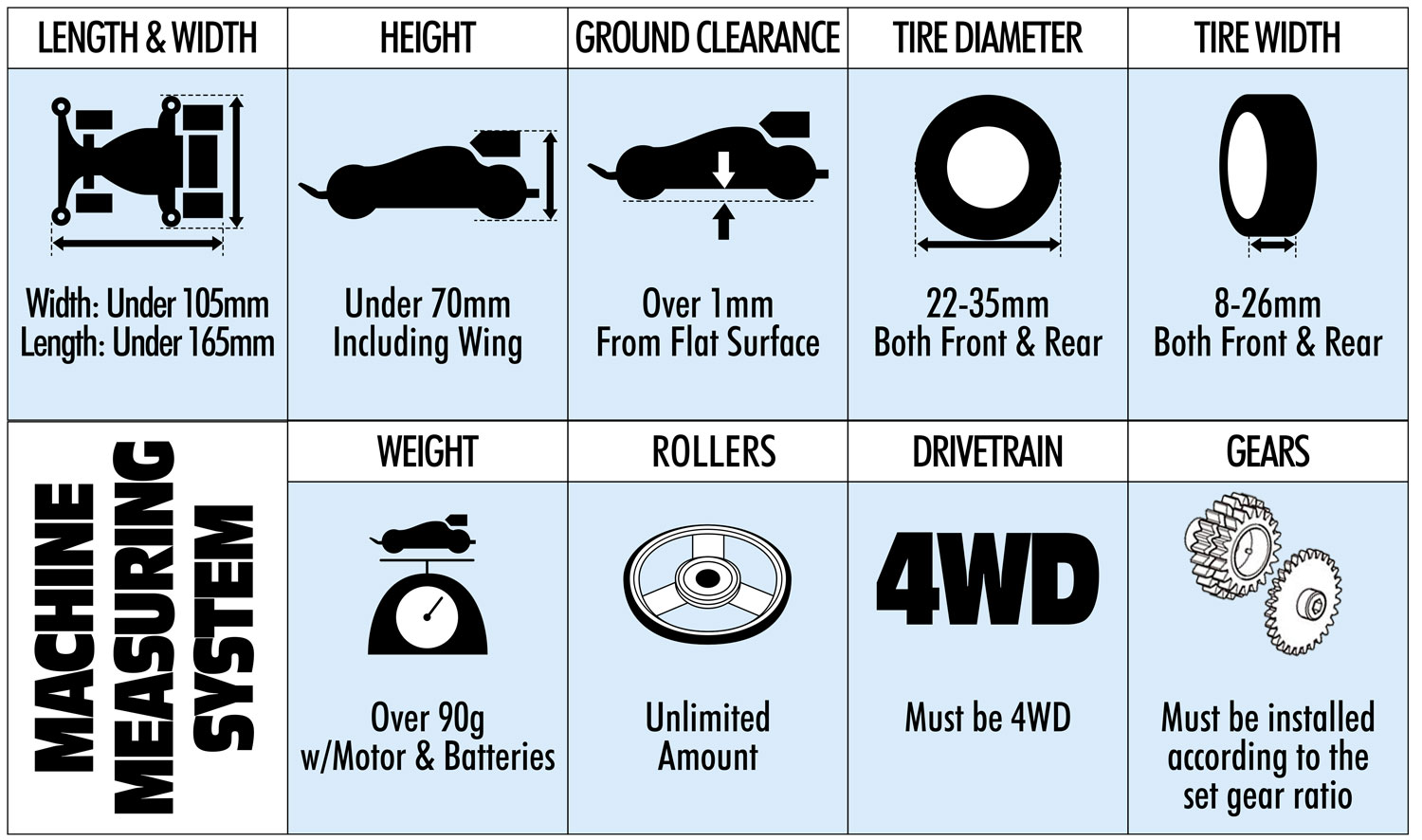
All machines must have a 4WD setup and will be subject to the same measuring system:
- Maximum Car Width: Under 105mm
- Overall Car Height: Under 70mm
- Overall Car Length: Under 165mm
- Minimum Ground Clearance: At least 1mm
- Minimum Car Weight (including batteries and motor): At least 90g
- Front and Rear Tires: Diameter: 22-35mm, Width: 8-26mm (Note that tires must be attached.)
- Rollers: There is no limit on the number of rollers that can be used.
- Mass Dampers: The installation positions of rotating mass dampers are no longer limited.
When adding parts(*1) to the car, please note the zone restrictions below:
- Parts may not be installed outside of the front tire, between the center of the front wheel and its rear edge.(*2)
- Parts may not be installed outside of the rear tire, between the center of the rear wheel and its front edge.(*2)
(*1) Bodies are the exception to this rule. Additionally, there are no restrictions on parts such as hi-mount rollers that are attached exclusively to the body if they are above the wheel axle.
(*2) A tire's "outside" is defined as its outermost edge. See the image at the bottom for a visual representation of the restricted areas.
Box Stock Class
Here are the rules that apply specifically to the Box Stock Racing Class:
- Kit Configuration: Vehicles must be assembled using only the parts included in the original kit. No optional hop-up parts are permitted unless explicitly allowed below.
- A-Parts: Use of all A-parts included in the kit is not mandatory.
- Gearing: The stock gear combination as supplied in the kit must be used. Altering gear ratios, substituting gears or making any modifications to the components is prohibited.
- Additional Parts / Hardware: Adding, swapping or substituting any parts or hardware not included in the original kit is not permitted.
- Batteries: Only alkaline or NiMH rechargeable batteries are allowed. Lithium-based batteries are prohibited.
- Battery Wrapping: Altering or removing original battery wrapping is prohibited. The manufacturer’s original battery wrapping must be clearly visible. Altered batteries will result in disqualification from that race.
- Body & Appearance: Bodies must be painted or display a minimum of two (2) decals.
Special Kits:
GT Animal kits and other special edition kits are permitted provided all non-stock added parts are removed and the motor is replaced with a Tamiya stock motor.
Prohibited Kits:
The following kits are not permitted in the Box Stock Class:
- EVO.1 series
- Vanquish Progress
- Avante Progress
- Starter Pack series
- Advanced Pack series
PRO-Stock Class
Here are the rules that apply specifically to the PRO-Stock Racing Class:
- Chassis: All legal Tamiya chassis are allowed.
- Rollers: Up to six (6) plastic rollers are allowed. This includes Tamiya upgrade Low Friction plastic roller sets and plastic double rollers. Non-plastic rollers are prohibited.
- Gearing: Only legal Tamiya gear combinations may be used. Gear ratios must remain within approved configurations. (refer to the Tamiya gear chart)
- Bearings: The following bearing types are permitted:
- Plastic bearings
- POM bearings
- Steel Bearing set #15393
- Metal bearing set #94381
- Eyelet insert bearings
- Motors: Only the following motors are permitted:
- 130 White Bell
- Rev Tuned II
- Rev Tuned II Pro
- Body: A Tamiya plastic body that properly fits the chassis must be used. No body modifications or alterations (cutting, reshaping or reinforcement) are allowed.
- Tires/Wheels: Any Tamiya tires or wheels are permitted provided they comply with tire regulations. Wheel piercing and tire stretching are prohibited.
- Modifications / Parts: Mixing and matching A-parts from other Tamiya kits is permitted. Altering, cutting or adding homemade or non-Tamiya parts is prohibited.
- Batteries: Only alkaline or NiMH rechargeable batteries are allowed. Lithium-based batteries are prohibited.
- Battery Wrapping: Altering, removing, or replacing original battery wrapping is prohibited. The manufacturer’s original wrapping must remain visible. Violations will result in disqualification from that race.
Basic Class
Here are the rules that apply specifically to the Basic Racing Class:
- Chassis: All non-modified, legal Tamiya chassis are permitted. Cutting, reshaping or reinforcing the chassis is not allowed.
- Rollers: All Tamiya plastic rollers are permitted with no restriction on quantity. Non-plastic rollers are prohibited.
- Gearing: Only legal Tamiya gear combinations may be used. Gear ratios must remain within approved configurations. (refer to the Tamiya gear chart)
- Bearings: The following bearing types are permitted:
- Plastic bearings
- POM bearings
- Steel Bearing set #15393
- Metal bearing set #94381
- Eyelet insert bearings
- Motors: All Tamiya-legal motors are permitted.
- Body: There must be a recognizable body on the car. A Tamiya plastic body that properly fits the chassis must be used. No body modifications or alterations (cutting, reshaping, reinforcement) are allowed.
- Tires/Wheels: Any Tamiya tires or wheels are permitted provided they comply with tire regulations. The following are prohibited:
- Wheel piercing
- Tire stretching
- Tire shaving, sanding or truing
- Plates and Stays: All legal Tamiya plastic, FRP and aluminum stays are permitted. Carbon stays are not allowed. Cutting, trimming, sanding or modifying stays in any way is prohibited.
- Mass Dampers: All off-the-shelf Tamiya mass damper sets, including sliding dampers, are permitted. Use of springs, elastic elements or non-standard gimmicks is prohibited.
- Tuning Sets: Tamiya Basic Tuning Sets and Starter Kits are recommended but not required for the Basic Class.
- Batteries: Only alkaline or NiMH rechargeable batteries are allowed. Lithium-based batteries are prohibited.
- Battery Wrapping: Altering, removing or replacing original battery wrapping is prohibited. The manufacturer’s original wrapping must remain visible. Violations will result in disqualification from that race.
Advanced Class
Here are the rules that apply specifically to the Advanced Racing Class:
- Chassis: All non-modified legal Tamiya chassis are permitted.
- Rollers: All Tamiya-manufactured rollers are permitted with no restriction on quantity. Custom anodizing is permitted provided the roller remains an original Tamiya part. Modified rollers, including altered sizes, lightweight machining or CNC-manufactured rollers, are not permitted.
- Gearing: Only legal Tamiya gear combinations may be used. Gear ratios must remain within approved configurations. (refer to the Tamiya gear chart)
- Bearings: All Tamiya bearings, including AO 620s and HG ball bearings, are permitted. Third-party ball bearings are prohibited.
- Motors: All Tamiya-legal motors are permitted.
- Body: There must be a recognizable body on the car. Both polycarbonate and plastic bodies are permitted. Alterations and modifications to plastic components are allowed solely for fitment and placement purposes. Creating new holes to secure the body onto no-cut systems is permitted.
- Tires/Wheels: Any Tamiya tires or wheels are permitted provided they comply with tire regulations. Wheel piercing is permitted. The following are prohibited:
- Tire stretching
- Tire shaving, sanding or truing
- Plates and Stays: All legal Tamiya plastic, FRP, aluminum and carbon stays are permitted. Cutting, trimming or sanding stays is not allowed. Countersinking is permitted and encouraged.
- Transmission Parts: Upgraded transmission components, including fluorine-coated shafts, hollow shafts, carbon-reinforced shafts and similar Tamiya upgrade parts, are permitted. Floating gear setups are not allowed.
- Mass Dampers: All off-the-shelf Tamiya mass damper sets, including sliding dampers, are permitted.
- Gimmicks / Adaptive Setups: All no-cut gimmick and adaptive setups are permitted, including but not limited to:
- Body lantern
- Pivot
- Anchor
- AT
- Sliding
- Aqua / Whale setups
- Tohoku Damper
- Guillotine Damper
- Doraemon Lantern
- Batteries: Only alkaline or NiMH rechargeable batteries are allowed. Lithium-based batteries are prohibited.
- Battery Wrapping: Altering, removing or replacing original battery wrapping is prohibited. The manufacturer’s original wrapping must remain visible. Violations will result in disqualification from that race.
BMAX Class
Here are the rules that apply specifically to the BMAX Racing Class:
- Chassis: All non-modified legal Tamiya chassis are permitted. Reverse use of the chassis is prohibited.
- Rollers: All Tamiya-manufactured rollers are permitted with no restriction on quantity. Custom anodizing is permitted provided the roller remains an original Tamiya part. Modified rollers, including altered sizes, lightweight machining or CNC-manufactured rollers, are not permitted.
- Gearing: Only legal Tamiya gear combinations may be used. Gear ratios must remain within approved configurations. (refer to the Tamiya gear chart)
- Bearings: All Tamiya bearings, including AO 620s and HG ball bearings, are permitted. Third-party ball bearings are prohibited.
- Motors: All Tamiya-legal motors are permitted.
- Body: There must be a recognizable body on the car. Both polycarbonate and plastic bodies are permitted. Alterations and modifications to plastic components are allowed solely for fitment and placement purposes. For animal Racer models, removing canopy parts to accommodate the figure is permitted. Mesh materials may be used to replace removed sections.
- Tires/Wheels: Any Tamiya tires or wheels are permitted provided they comply with tire regulations. Wheel piercing is permitted. The following are prohibited:
- Tire stretching
- Tire shaving, sanding or truing
- Plates and Stays: All legal Tamiya plastic, FRP, aluminum and carbon stays are permitted. Cutting, trimming, adding new holes or sanding stays is not allowed. Countersinking and through-hole processing are allowed.
- Transmission Parts: Upgraded transmission components, including fluorine-coated shafts, hollow shafts, carbon-reinforced shafts and similar Tamiya upgrade parts, are permitted. Floating gear setups are not allowed.
- Mass Dampers: All off-the-shelf Tamiya mass damper sets are permitted.
- Gimmicks / Adaptive Setups: No-cut gimmick and adaptive setups based on the Tamiya upgraded slide damper and ball link mass damper are permitted.
- Batteries: Only alkaline or NiMH rechargeable batteries are allowed. Lithium-based batteries are prohibited.
- Battery Wrapping: Altering, removing or replacing original battery wrapping is prohibited. The manufacturer’s original wrapping must remain visible. Violations will result in disqualification from that race.
Open Class
Here are the rules that apply specifically to the Open Racing Class:
- Chassis: All Tamiya chassis are permitted and may be modified.
- Rollers: All Tamiya-manufactured rollers are permitted with no restriction on quantity. Custom anodizing, lightweight processing and CNC machining are permitted provided the roller remains an original Tamiya part. Altering rollers to non-legal sizes or modifying the plastic rings on rollers is prohibited.
- Gearing: Only legal Tamiya gear combinations may be used. Gear ratios must remain within approved configurations. (refer to the Tamiya gear chart)
- Bearings: All Tamiya bearings are permitted.
- Motors: All Tamiya-legal motors are permitted.
- Body: There must be a recognizable body on the car. Both polycarbonate and plastic bodies are permitted and may be modified. A wing or leftover part alone does not qualify as a body.
- Tires/Wheels: Any Tamiya tires or wheels are permitted and may be modified provided they comply with tire regulations.
- Plates and Stays: All legal Tamiya plastic, FRP, aluminum and carbon stays are permitted. Cutting, trimming, gluing or sanding stays is permitted.
- Transmission Parts: Upgraded transmission components, including fluorine-coated shafts, hollow shafts, carbon-reinforced shafts and other Tamiya upgrade parts, are permitted. Floating gear setups, including but not limited to shimming, clamping or altering, are allowed.
- Mass Dampers: All Tamiya mass damper sets and permitted modifications are allowed.
- Gimmicks / Adaptive Setups: All system setups using Tamiya parts are permitted.
- Batteries: Only alkaline or NiMH rechargeable batteries are allowed. Lithium-based batteries are prohibited.
- Battery Wrapping: Altering, removing or replacing original battery wrapping is prohibited. The manufacturer’s original wrapping must remain visible. Violations will result in disqualification from that race.